

If you’re staring at a map of Spain trying to figure out where to even start, take a breath — you picked a good one. Spain is one of those rare destinations that rewards first-time visitors without punishing them for being new. The food is incredible almost everywhere, the train system does a lot of the hard work for you, and the country’s biggest cities each have such a distinct personality that even a fairly simple itinerary ends up feeling varied and full.
This guide is built specifically for first-timers. It won’t try to cram in every region of Spain or convince you that you need three weeks and a rental car. Instead, think of it as a practical planning session with a friend who’s done this before: which cities actually belong on a first trip, how many days you really need, how to get between places without stress, and the small logistical details that make everything smoother once you land. By the end, you should have a clear, realistic route in mind — and the confidence to book it.
Why Spain Is a Great First International Trip
Spain has a few qualities that make it especially forgiving for a first-time visitor, whether this is your first trip to Europe or just your first trip to Spain specifically.
The variety is real, but the distances are manageable. In a relatively compact country, you can go from the art museums and royal palaces of Madrid to the Gaudí-filled streets of Barcelona to the flamenco bars of Sevilla to the Moorish palaces of Granada — and none of those transitions requires a full day of travel.
The infrastructure is excellent. Spain’s high-speed rail network connects its major cities quickly and comfortably, which means first-timers can build a multi-city itinerary without renting a car or piecing together budget flights.
Every major city feels different. This matters more than people expect. A lot of countries have a “if you’ve seen one city, you’ve seen them all” problem. Spain doesn’t. Madrid feels grand and central. Barcelona feels coastal and architectural. Sevilla feels warm and traditional. Granada feels layered with history. That contrast is part of what makes a first Spain trip so satisfying.
It balances icons with everyday life. Yes, you’ll see the Sagrada Família and the Alhambra. But Spain also rewards slower moments — long lunches, plazas at golden hour, wandering a tapas bar with no real plan. First-timers often leave saying the in-between moments were their favorite part.
What First-Time Travelers Should Know Before Visiting Spain
Before you get into route-planning, a few practical basics will make your trip noticeably easier.
City transport is strong and easy to use. Major cities like Madrid and Barcelona have reliable metro, bus, and train networks, and most historic centers are compact and walkable once you’re there. You generally won’t need a car within a city — and in most cases, a car will actively work against you in dense historic centers with limited parking.
Meal times run later than you’re used to. Lunch in Spain typically stretches from around 1:30 to 3:30 in the afternoon, and dinner often doesn’t start until 9 p.m. or later. This isn’t a quirk to work around — it’s part of the rhythm of the country, and planning your day loosely around it (rather than fighting it) will make your trip feel a lot more natural.
Tourist passes and city cards can save you real money. Many major cities offer discount cards that bundle entry to museums and monuments, and some attractions offer reduced-price or free entry during specific hours. It’s worth a quick search for your specific cities before you go.
Buy tickets from official or authorized sellers only. Popular sights like the Alhambra and the Sagrada Família sell out ahead of time, especially in peak season, and third-party resellers can be unreliable or overpriced. Book directly through official sites as early as you can.
Book hotels early around festivals and holidays. Spain has a packed calendar of local festivals, and accommodation in affected cities can fill up or spike in price well in advance. If your trip overlaps with a known festival, lock in lodging early.
Have a mix of cash and card on hand. Card payment is widely accepted in cities, but smaller bars, markets, and rural spots may prefer cash, so it’s smart to carry some euros as backup.
The Best First-Timer Route for Spain
Once you know the basics, the real question is: which cities actually belong on your first trip?
For most first-time visitors, the most balanced route centers on four cities: Barcelona, Madrid, Sevilla, and Granada. Together, they cover Spain’s biggest architectural icons, its best food scenes, its royal and artistic history, and its Andalusian character — without spreading you too thin.
If your trip is shorter, the smart move is to scale back the number of cities rather than trying to rush through all four. A common and reliable approach: start with Madrid, since it’s central and easy to combine with a quick day trip to nearby Toledo. If you have more time, add Barcelona. And if your trip stretches toward the ten-day mark or longer, that’s when adding Sevilla and Granada starts to make sense, giving you a fuller picture of the country from its capital to its south.
The goal isn’t to see everything Spain offers on your first visit — it’s to choose a route that lets each city breathe a little, so you’re not constantly living out of a suitcase.
Best Spain Itinerary by Trip Length
Here’s how to think about your route depending on how many days you have.
5 days in Spain Keep it to two cities: Barcelona and Madrid. This gives you roughly 2–3 days in each, enough time to see the major sights without feeling rushed, plus some room to just wander.
7 days in Spain Madrid, Barcelona, and one extra stop. Toledo works well as a day trip from Madrid, or you could swap in a short add-on like Sevilla if you’re willing to move a bit faster.
10 days in Spain This is the sweet spot for the classic first-timer route: Madrid, Barcelona, Sevilla, and Granada. Ten days gives each city enough time to feel real rather than rushed, and it lets you experience both central Spain and the south.
14 days in Spain With two weeks, you can keep the same core route and add depth — an extra day in each city, a stop in Córdoba between Sevilla and Granada, or a detour to Toledo. Fourteen days is also enough time to slow down and add a beach or coastal stretch if you want variety beyond cities.
Whatever your timeline, resist the urge to add “just one more city.” A slightly shorter list of cities, explored properly, almost always beats a packed list rushed through.
Must-Visit Cities for a First Trip to Spain
Here’s a closer look at the cities that make up the classic first-timer route, and what each one brings to your trip.
Madrid — art, royal sights, and a central home base Madrid is Spain’s capital and a natural starting point for many itineraries. It’s home to world-class art museums, grand royal architecture, and a lively tapas and plaza culture that makes evenings easy to fill. It’s also centrally located, which makes it a convenient jumping-off point for day trips. Ideal stay: 2–3 days Best for: museums, royal history, central logistics First-timer note: Madrid pairs naturally with a day trip to Toledo if you have an extra day to spare.
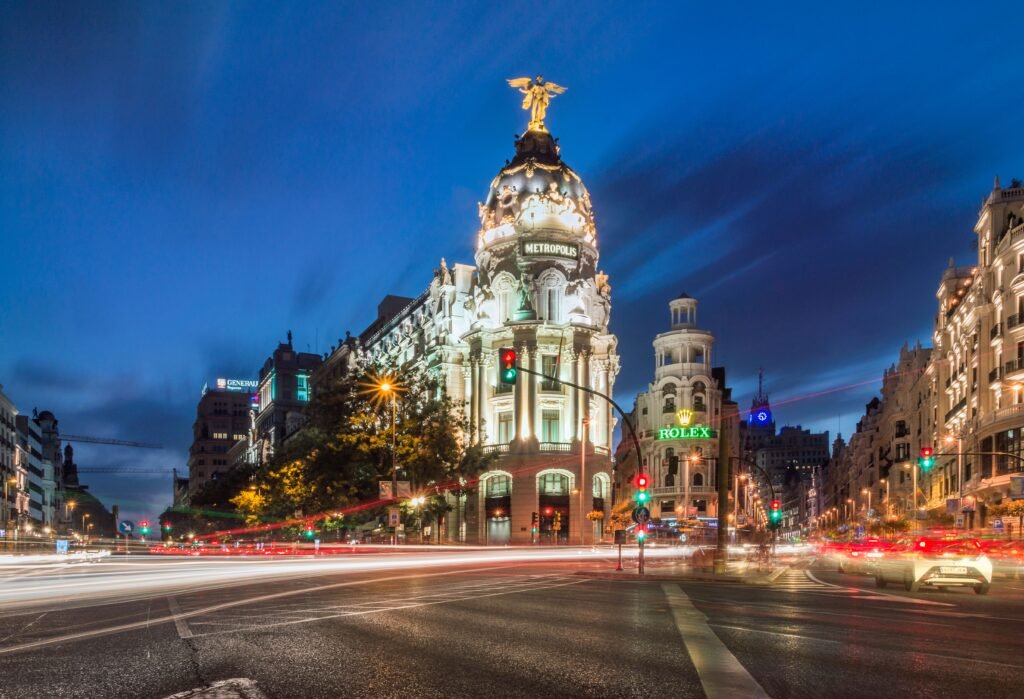
Barcelona — architecture and Mediterranean energy Barcelona is Spain’s most architecturally distinctive city, largely thanks to Gaudí’s work scattered throughout it. Add in a Mediterranean coastline, a lively food scene, and neighborhoods that each have their own feel, and it’s easy to see why this is a first-timer favorite. Ideal stay: 2–3 days Best for: architecture, coastal atmosphere, walkable neighborhoods First-timer note: Book major sights like the Sagrada Família well in advance — they sell out.
Sevilla — Andalusian charm and flamenco energy Sevilla brings a warmer, more traditional atmosphere than Madrid or Barcelona. It’s known for flamenco, striking Moorish-influenced architecture, and a slower, sun-soaked pace that many first-timers end up loving most. Ideal stay: 2 days Best for: flamenco, Andalusian architecture, atmosphere First-timer note: Evenings here are especially lively — don’t plan an early dinner.
Granada — the Alhambra and layered history Granada’s biggest draw is the Alhambra, a sprawling Moorish palace and fortress complex that’s one of Spain’s most memorable sights. The city itself carries centuries of layered history in its streets, making it a rewarding stop even beyond its headline attraction. Ideal stay: 2 days Best for: the Alhambra, history, a slower pace First-timer note: Alhambra tickets are timed and limited — book these before anything else on your trip.
Toledo — the easy short add-on from Madrid Toledo isn’t a standalone stop for most first-timers, but as a day trip from Madrid, it punches well above its weight. Its walled historic center and hilltop setting make it feel like a different era entirely, all within about half an hour of the capital by train. Ideal stay: half a day to a full day Best for: an easy, high-impact day trip First-timer note: You can visit and return to Madrid the same day without rushing.
How to Get Around Spain Without Stress
Spain’s transportation network is one of the biggest reasons it works so well for first-timers, and getting a basic feel for it before you go will save you a lot of guesswork.
High-speed trains (AVE) are your best friend for city-to-city travel. Spain’s AVE trains connect major cities quickly and comfortably — Madrid to Barcelona, for example, takes roughly 2.5 to 3 hours, often faster and less hassle than flying once you account for airport time. For a classic first-timer itinerary bouncing between major cities, trains should be your default.
Domestic flights make sense for longer distances. If your route includes cities that are farther apart or not well connected by rail, a short domestic flight can be worth it. But for the core Madrid–Barcelona–Sevilla–Granada route, trains and buses generally cover you well.
Buses fill in the gaps. Spain’s bus network is extensive and useful for smaller towns or routes where trains aren’t practical.
Skip the rental car for a classic city-based itinerary. Driving in dense historic centers is often more stressful than helpful, and parking can be a real headache. A car becomes genuinely useful if you’re exploring rural regions, wine country, or areas like the Balearic or Canary Islands — but for a first-timer’s city-focused route, public transportation is not just sufficient, it’s usually the better choice.
The bottom line: for most first-time itineraries, you can book trains between cities and rely on walking or local metro once you’re there. It’s one less thing to worry about.
Where to Stay in Spain on a First Trip
Picking the right neighborhood matters more than picking the “best” hotel. A well-located but modest hotel usually beats a fancier one that leaves you far from where you’ll actually spend your time.
Stay central and walkable. In each city, look for accommodation in or near the historic center. You’ll spend less time and money on transport, and you’ll be able to wander back to your hotel for a midday break — useful given how the meal schedule runs.
Book early around festivals and peak season. Spain hosts numerous local festivals throughout the year, and accommodation in the host city can fill up or jump in price well ahead of time. If your travel dates overlap with a major event, book your hotel as early as you lock in your dates.
Hotels are generally a strong value. Spain has a reputation for solid, reasonably priced hotels compared to some other major European destinations, so you don’t need to overspend to get a comfortable, well-located stay.
Consider apartments for longer stays. If you’re spending 3+ days in one city, a short-term apartment rental can offer more space and a kitchen, which is handy for a slower-paced day or two mixed into your itinerary.
Spain Travel Mistakes First-Timers Should Avoid
A few common missteps tend to show up again and again in first-timer trip planning — here’s how to sidestep them.
- Trying to see too much. Spain rewards a focused route more than a packed one. Four well-chosen cities beat six rushed ones.
- Packing in too many one-night stops. Constantly moving hotels eats up time and energy. Where possible, stay two or more nights per city.
- Underestimating transit time. Even fast trains still take a few hours, and getting to and from stations adds time too. Build in breathing room.
- Ignoring local meal hours. Showing up for dinner at 6 p.m. often means empty restaurants or limited options. Adjust your schedule to match local rhythms.
- Assuming every city feels the same. Madrid, Barcelona, Sevilla, and Granada each have a distinct personality — don’t treat your itinerary like a checklist of interchangeable stops.
- Overcomplicating transport. You likely don’t need a rental car for a classic multi-city itinerary. Trains and walking will get you further with less stress.
- Waiting too long to book major sights or hotels. Popular attractions and festival-season hotels sell out. Lock in the big-ticket items early.
A Sample 10-Day First-Timer Spain Itinerary
If you want a concrete starting point, here’s a realistic ten-day route that covers the classic first-timer cities without overpacking the schedule.
Days 1–3: Barcelona Ease into the trip with Gaudí’s landmarks, the Gothic Quarter, and the Mediterranean waterfront. Use the extra day to slow down — a market visit, a beach afternoon, or simply wandering a neighborhood without a plan.
Days 4–6: Madrid Take the high-speed train to Madrid. Spend your days between the major art museums, royal sights, and plaza culture, and use one day for a side trip to Toledo.
Days 7–8: Sevilla Head south by train for a change of pace. Take in the Andalusian architecture, catch a flamenco show, and enjoy the slower, warmer atmosphere.
Days 9–10: Granada Finish in Granada with the Alhambra as your headline stop — book those tickets well before your trip. Spend your final day soaking in the city’s layered history before heading home.
This structure keeps travel days minimal, gives each city enough time to feel real, and follows a natural geographic flow rather than backtracking across the country.
FAQ
What is the best first-time itinerary for Spain? For most first-timers, a route through Madrid, Barcelona, Sevilla, and Granada offers the best balance of major sights, food, and regional variety. Shorter trips can scale back to just Madrid and Barcelona.
How many days do you need in Spain? Five days is enough for a solid two-city trip (Barcelona and Madrid), while ten days allows for the fuller four-city route. Fourteen days gives room to slow down or add an extra stop like Córdoba.
Is Spain easy for first-time travelers? Yes. Spain’s strong train network, walkable city centers, and distinct-but-connected major cities make it one of the more approachable countries for a first international or first Europe trip.
Should I visit Madrid or Barcelona first? There’s no wrong answer — both work well as a starting point. Madrid’s central location makes it convenient if you’re also adding Toledo, Sevilla, or Granada, while Barcelona is a good pick if you want to ease in with a coastal, architecture-focused city first.
What is the best way to get around Spain? High-speed AVE trains are the best option for traveling between major cities, with buses filling in smaller routes. A rental car is generally unnecessary for a classic city-based first-timer itinerary.
What should I know before traveling to Spain? Plan around local meal times (late lunches and even later dinners), book major attractions and festival-season hotels in advance, buy tickets only from official sellers, and take advantage of city tourist passes where available.
Final Thoughts
Your first trip to Spain doesn’t need to cover everything. It just needs the right mix of cities, enough breathing room between them, and a route that lets you actually enjoy the country instead of racing through it. Whether you land on a tight five-day trip through Barcelona and Madrid or a fuller ten-day loop down through Sevilla and Granada, the framework is the same: fewer cities, more time in each, and a rhythm that matches how Spain actually moves.
Pick your route, book your trains, and get ready — Spain has a way of making first-timers feel like they’ll be back before they’ve even left.