
Tokyo is one of the most photogenic cities on Earth, and the truth is, you don’t need a paid observation deck ticket or a professional camera to prove it. Some of the best shots you’ll ever get here come from a temple gate at sunrise, a bridge view of Skytree, or a free elevator ride to the 45th floor of a government building.
Not every great Tokyo photo requires a fancy deck or a fat wallet. Some of the city’s best views are hiding in plain sight — on public streets, at shrine approaches, and inside buildings most tourists walk right past. This guide rounds up 15 spots that cost nothing to visit and still deliver the kind of shots people ask about when they see your feed.
Quick answer: the best free Tokyo photo spots at a glance
- Best skyline view: Tokyo Metropolitan Government Building Observation Deck (Shinjuku)
- Best classic Tokyo street shot: Shibuya Scramble Crossing
- Best traditional atmosphere: Senso-ji and Nakamise-dori (Asakusa)
- Best night photo spot: Golden Gai (Shinjuku)
- Best spot for first-timers: Takeshita Street (Harajuku)
- Best underrated free viewpoint: LUFTBAUM at Takanawa Gateway
What makes a Tokyo photo spot worth visiting
Before the list, it helps to know what separates a genuinely good free photo spot from a spot that just shows up on every “Tokyo bucket list” post. A location earns its place here if it has:
- Visual impact — it actually looks like Tokyo, not just any city
- Free access — no ticket, no reservation, no minimum purchase
- Ease of reaching it — a normal train ride or walk, not a detour that eats your whole day
- Uniqueness — it gives you a type of shot the other 14 spots don’t
- Fit with sightseeing — you’d likely walk past it anyway on a normal Tokyo itinerary
With that filter applied, here’s the list.
The 15 best free Tokyo photo spots
1. Tokyo Metropolitan Government Building Observation Deck
Best for: Panoramic skyline shots, Mt. Fuji on clear days Why it’s worth it: This is the one everyone should know about and most first-timers don’t. The building’s twin towers each have a free observatory 202 meters up, and on a clear day you can see Skytree, Tokyo Bay, and sometimes Mt. Fuji, all without paying a yen. Best time to shoot: Early evening for the blue-hour transition into the city lights, or after rain in winter when the air is clearest. Quick tip: There’s a bag check before the elevator, and the north and south towers alternate closing days, so it’s worth checking hours before you go. The south deck also runs a free nightly projection-mapping show on the building’s exterior after sunset.
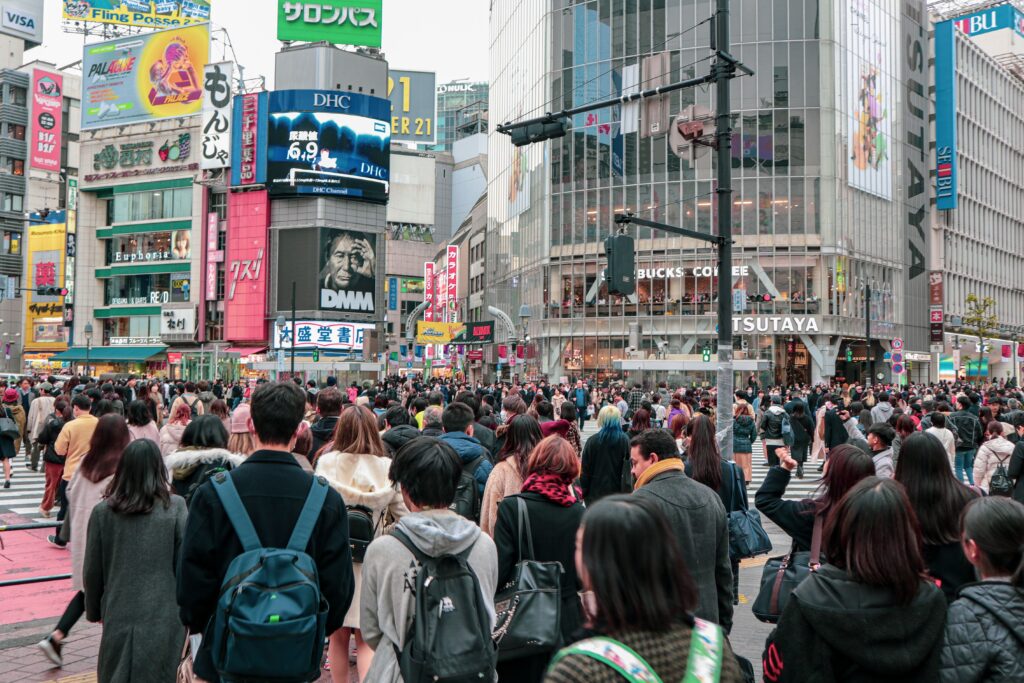
2. Shibuya Scramble Crossing
Best for: The single most recognizable “this is Tokyo” street shot Why it’s worth it: No list like this is complete without it, and it earns the spot honestly. Hundreds of people crossing in every direction at once, framed by giant video screens, is Tokyo energy distilled into one intersection. Best time to shoot: Dusk, right as the neon starts competing with the fading daylight — you get both the crowd chaos and the glow. Quick tip: Skip trying to shoot from street level in the middle of the crush. Head into one of the surrounding cafes or building entrances with upper-floor windows for a cleaner overhead angle, free of charge, no purchase required at most of them if you’re just passing through to look.
3. Senso-ji and Nakamise-dori, Asakusa
Best for: Traditional atmosphere, lanterns, old Tokyo character Why it’s worth it: This is Tokyo’s oldest temple, and the approach through Nakamise-dori’s shopping street, capped by the giant red Kaminarimon lantern, is one of the most reliably beautiful free scenes in the city. Best time to shoot: Early morning, ideally before 8am, when the shopping street is quiet and the lantern isn’t buried in a wall of people. Quick tip: The temple grounds themselves are free to enter. Come back at night, too — the lanterns are lit and the crowds thin out dramatically.
4. Takeshita Street, Harajuku
Best for: Youth culture, color, first-timer energy Why it’s worth it: If you want a shot that says “Tokyo is fun and a little chaotic,” this narrow, crepe-shop-lined street delivers it better than almost anywhere else in the city. Best time to shoot: Weekday mornings if you want the street mostly to yourself; weekend afternoons if you actually want the crowd in the shot for atmosphere. Quick tip: This is a genuinely good first stop for visitors, since it’s a short walk from Harajuku Station and connects naturally into Meiji Shrine and Omotesando.
5. Meiji Shrine forest approach
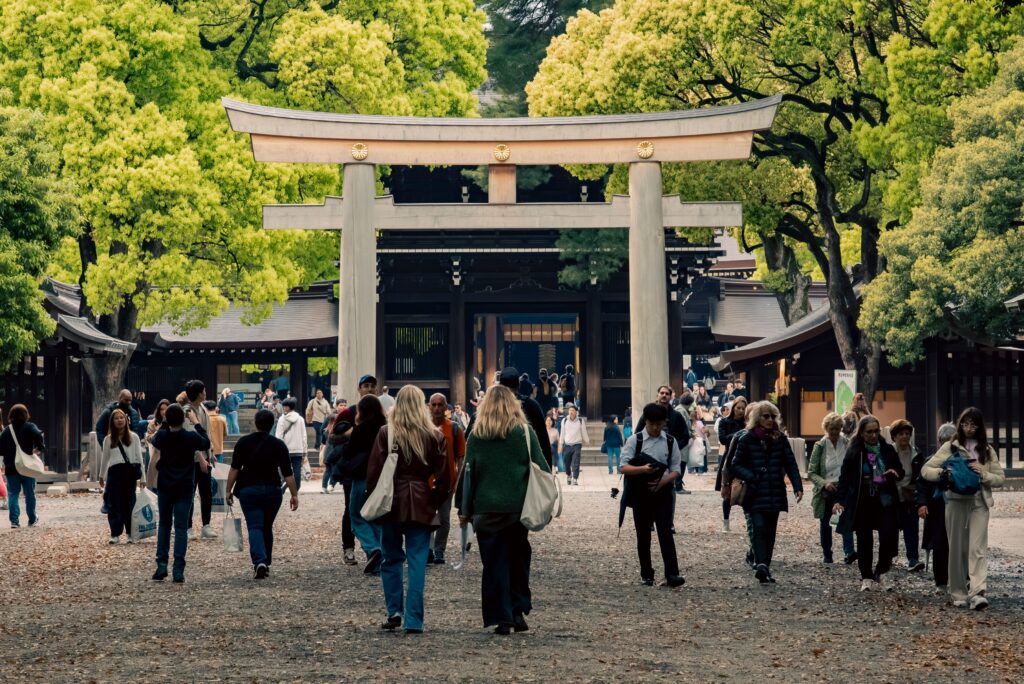
Best for: A quieter, more elegant composition — deep green, quiet torii gates Why it’s worth it: A few minutes from the chaos of Takeshita Street sits a forested shrine approach that feels like a completely different city. The gravel path under the trees, leading to the giant wooden torii gate, is a genuinely peaceful contrast shot to pair with the neon and crowds elsewhere on this list. Best time to shoot: Early morning, right after opening, for empty paths and soft light through the trees. Quick tip: The shrine grounds are free; only the inner garden requires a small fee, so you can get excellent shots without paying anything.
6. Yanaka Ginza
Best for: Old-school neighborhood character, low-rise Tokyo Why it’s worth it: One of the few Tokyo neighborhoods that survived both the 1923 earthquake and WWII bombing largely intact, Yanaka Ginza is a shopping street full of small shops, cats, and a strong “real Tokyo” feel that’s genuinely hard to fake elsewhere. Best time to shoot: Late afternoon, when the light comes in low down the street and local shops are busiest. Quick tip: Walk up Yuyake Dandan, the small staircase at the entrance to the street — it’s a well-known framing spot that gives you the whole street in one shot.
7. Nakameguro riverside
Best for: Riverside composition, cherry blossoms in season Why it’s worth it: The Meguro River isn’t dramatic on its own, but the walking path lined with trees and small cafes makes for a relaxed, photogenic stretch year-round, and it becomes one of Tokyo’s best free cherry blossom spots in late March and early April. Best time to shoot: Late afternoon on a normal day; early morning during cherry blossom season, before the crowds arrive. Quick tip: Outside of sakura season, this spot is genuinely uncrowded, which makes it a good choice if you want a calmer, less staged-feeling Tokyo photo.
8. Caretta Shiodome — Sky View
Best for: Tokyo Bay, Rainbow Bridge, Odaiba skyline Why it’s worth it: This free observation floor sits around 210 meters up and looks out over the bay instead of the city center, giving you a genuinely different skyline shot than the Shinjuku-area decks. Best time to shoot: Evening, when Rainbow Bridge lights up and the bay reflects the city glow. Quick tip: It’s a short walk from Shimbashi Station, so it pairs easily with a day that includes Ginza or the Hamarikyu Gardens area.
9. Yebisu Garden Place Tower — Sky Lounge
Best for: A balanced view combining Tokyo Tower, Skytree, and Rainbow Bridge Why it’s worth it: At around 160 meters, it’s the shortest of the free decks on this list, but the angle gives you multiple Tokyo landmarks in a single frame, which is genuinely useful if you only have time for one skyline stop. Best time to shoot: Late evening — it stays open later than most of the other free decks, so it’s a good option if your day runs long. Quick tip: The building itself, Yebisu Garden Place, is worth a slow walk before you go up, especially around the fountain plaza.
10. Odaiba waterfront and Rainbow Bridge
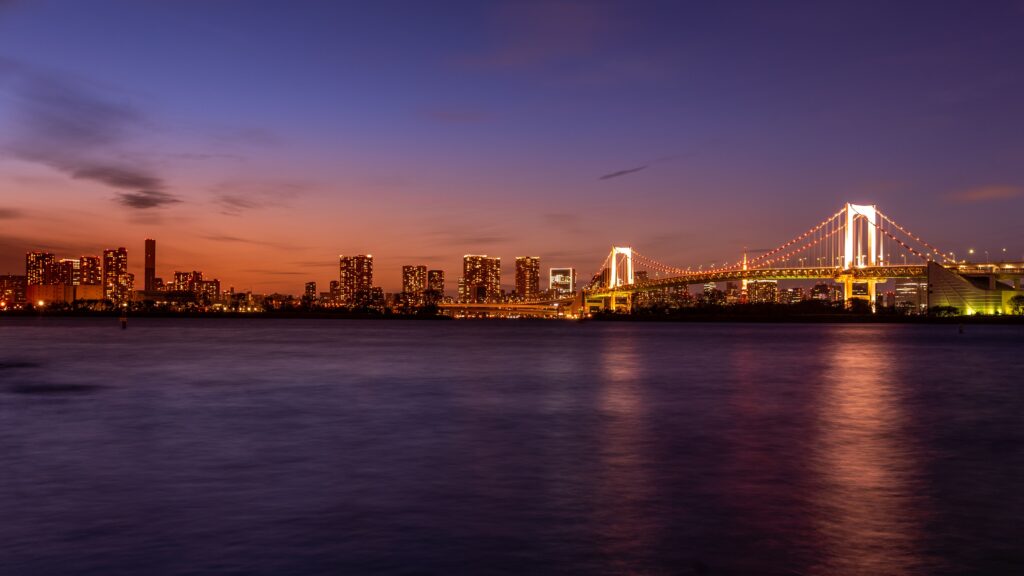
Best for: Modern, wide-open skyline shots with water in the frame Why it’s worth it: Odaiba gives you a completely different feel than central Tokyo: open sky, the bay, Rainbow Bridge, and a skyline view back toward the city that most first-timers never bother to shoot. Best time to shoot: Blue hour, when Rainbow Bridge’s lights turn on and the skyline behind it starts to glow. Quick tip: The promenade near Odaiba Marine Park is free and gives you an unobstructed line on both the bridge and the skyline — no ticket required for the view itself.
11. Golden Gai, Shinjuku
Best for: Neon alley atmosphere, moody night shots Why it’s worth it: This tiny cluster of narrow alleys packed with dozens of closet-sized bars is one of the most photogenic neon scenes in Tokyo, and simply walking through it costs nothing. Best time to shoot: After dark, once the signs are lit — this area doesn’t really exist visually until the sun goes down. Quick tip: You’re welcome to photograph the alleys themselves, but be respectful around bar entrances and avoid photographing patrons without asking. The lanes are narrow, so a phone will actually serve you better than a bulky camera setup here.
12. Shimokitazawa streets
Best for: Indie, vintage, laid-back Tokyo Why it’s worth it: If Harajuku feels too loud and Shibuya too corporate, Shimokitazawa’s tangle of small streets, vintage shops, and murals gives you a completely different, more textured version of Tokyo street photography. Best time to shoot: Late morning to early afternoon, when shops are open but the streets aren’t packed. Quick tip: There’s no single “must-shoot” landmark here — it rewards slow wandering more than any other spot on this list, which makes it a good choice on a lighter sightseeing day.
13. Sumida River near Azumabashi Bridge
Best for: The classic postcard shot of Tokyo Skytree Why it’s worth it: From the riverside near Azumabashi Bridge, you get Skytree, the gold Asahi Beer Hall building, and the river all in one frame — genuinely one of the most reproduced Tokyo skyline shots, and it’s completely free. Best time to shoot: Sunset into blue hour, when Skytree’s lights come on and the river picks up the color. Quick tip: This pairs naturally with an Asakusa visit — walk from Senso-ji down to the river and you’ve covered two spots on this list in one afternoon.
14. Nezu Shrine torii gate path
Best for: A quieter, more elegant temple shot without the crowds of Senso-ji Why it’s worth it: Nezu Shrine’s row of vermilion torii gates gives you a similar visual to Kyoto’s famous shrine paths, at a fraction of the crowd, and the main shrine grounds are free to enter. Best time to shoot: Weekday mornings for empty gates; the shrine is genuinely quiet outside of the spring azalea festival. Quick tip: If you visit during the azalea festival in April, note that the garden area charges a small entry fee during that period — the shrine and torii path themselves remain free year-round.
15. LUFTBAUM at Takanawa Gateway
Best for: A newer, less crowded free skyline stop Why it’s worth it: One of the newest free observation spots in Tokyo, this rooftop-area viewpoint near Takanawa Gateway Station gives you a skyline angle most visitors haven’t discovered yet, without the lines you’ll find at the more famous decks. Best time to shoot: Evening — it stays open later than most, making it a good closing stop for a long day. Quick tip: Because it’s newer and less known, it’s a genuinely good pick if the Shinjuku deck lines are long or you want a spot without a crowd of other photographers in your frame.
Best free skyline photo spots in Tokyo
If skyline shots are your priority, these four cover the widest range: the Tokyo Metropolitan Government Building for the classic 360-degree city view, Caretta Shiodome for the bay and Rainbow Bridge, Yebisu Garden Place Tower for a multi-landmark frame in one shot, and LUFTBAUM at Takanawa Gateway if you want a newer angle without the crowds. You genuinely don’t need to pay for Skytree or Shibuya Sky to come home with strong skyline photos.
Best Tokyo street photo spots for first-time visitors
If you want energy over panoramas, prioritize Shibuya Scramble Crossing, Takeshita Street, and Golden Gai. These three alone will give you the crowded-crossing shot, the colorful youth-culture shot, and the moody neon-alley shot — three completely different moods, all within a short train ride of each other.
Best traditional-looking Tokyo photo spots
For lanterns, shrine gates, and old streets, go with Senso-ji and Nakamise-dori, Meiji Shrine, Yanaka Ginza, and Nezu Shrine. These give you traditional atmosphere without needing to leave the city, and none of them charge admission for the areas that photograph best.
Best time of day to photograph Tokyo
You don’t need technical photography knowledge to time your shots well — just a few general rules:
- Morning (before 9am) is your best window for temple approaches and famous streets without crowds in the frame.
- Late afternoon gives softer, warmer light, especially good for riverside and neighborhood shots.
- Blue hour and night are when neon districts and skyline decks come alive — this is when Shibuya Crossing, Golden Gai, and the observation decks actually look their best.
- Clear winter days, especially after rain, offer the least haze, which matters most if you’re hoping to catch Mt. Fuji from a skyline viewpoint.
Tokyo photo mistakes first-time visitors make
- Trying to hit too many spots in one day and rushing every shot
- Showing up at famous spots midday, when crowds and harsh light both work against you
- Paying for a viewpoint like Shibuya Sky or Tokyo Skytree without realizing a free deck nearby gives a comparable shot
- Picking spots purely off social media without checking how far apart they actually are
- Ignoring the weather — a hazy day will quietly ruin a skyline shot no matter how good the spot is
Suggested 1-day free photo route for first-time visitors
If you only have one day to dedicate to photography, this route groups several spots on this list into a logical loop:
- Morning: Senso-ji and Nakamise-dori (Asakusa), then walk to the Sumida River near Azumabashi Bridge for the Skytree shot
- Midday: Head to Yanaka Ginza for old-neighborhood character and lunch
- Afternoon: Take the train to Harajuku for Meiji Shrine, then Takeshita Street
- Evening: Move to Shibuya for the Scramble Crossing at dusk
- Night: Finish in Shinjuku with the Tokyo Metropolitan Government Building Observation Deck, then a walk through Golden Gai
FAQ
What are the best photo spots in Tokyo? The strongest all-around spots include the Tokyo Metropolitan Government Building Observation Deck, Shibuya Scramble Crossing, Senso-ji in Asakusa, and the Sumida River view of Skytree — all free.
Where can I take skyline photos in Tokyo for free? The Tokyo Metropolitan Government Building, Caretta Shiodome’s Sky View, Yebisu Garden Place Tower’s Sky Lounge, and LUFTBAUM at Takanawa Gateway are all free observation points with genuinely different skyline angles.
Are there free observation decks in Tokyo? Yes. Several of Tokyo’s tallest buildings, including government offices and commercial towers, offer free public observation floors, unlike paid decks such as Tokyo Skytree or Shibuya Sky.
What is the best Tokyo photo spot for first-time visitors? Shibuya Scramble Crossing and Takeshita Street in Harajuku are the easiest, most rewarding first stops — both are simple to reach and instantly recognizable as Tokyo.
Can you photograph Tokyo well without paying for attractions? Yes. Free shrines, streets, riverside walks, and public observation decks can cover skyline, street, and traditional-atmosphere shots without a single ticket purchase.
What time of day is best for Tokyo photos? Early morning for temples and famous streets, late afternoon for riverside and neighborhood shots, and blue hour or night for skyline decks and neon districts.
The takeaway
Tokyo rewards curious walkers and good timing more than expensive tickets. The best photos in this city aren’t locked behind an admission fee — you just need to know where to look, when to show up, and how to string a few of these spots together into a day that actually makes sense to walk.
Planning the rest of your trip? Check out our guides to where to stay in Tokyo for first-time visitors, and the best eSIM for Japan to round out your itinerary.